





As American households continue to face high food prices and farming communities contend with low margins, a new report from American Commitment argues that the most effective way to support American farmers and lower food prices is not through expanded subsidies or regulatory mandates, but through continued investment in U.S.-led agricultural innovation.
The report, The Right to Reap: Protecting the Innovation Keeping American Farms Competitive, examines the economics of U.S. agriculture by drawing on key data from the United States Department of Agriculture and the American Farm Bureau Federation and case studies of recent ag tech innovations. The report details concrete ways in which high-quality, high-tech American equipment is already directly helping farmers and producers reduce their use of expensive inputs, as well as the even greater potential impacts of continued progress yet to come.
To support and continue this success story, policymakers should support a smart regulatory framework and property rights protections that foster innovation and greater prosperity.
“Innovation in the agricultural sector is already lowering costs and increasing efficiency in food production,” said Phil Kerpen, president of American Commitment. “And the sector is ripe for even further benefits. The United States should continue to encourage investment in agricultural technology and protect farmers’ and all Americans’ right to reap the benefits.’”
The report opens by situating agriculture within the broader inflationary pressures that followed the 2021-22 surge in federal spending, describing the resulting inflation as “a stubbornly persistent challenge” for the cyclical farm economy.
These losses come at a time when the industry is more important than ever — accounting for 18.7 percent of the national economy and supporting more than 47 million jobs that consumers rely on to put food on the shelves.
According to U.S. Department of Agriculture data cited in the report, major crops such as corn, soybeans, cotton, and wheat have not been profitable since at least 2022, with projections showing growers could see roughly $44 billion in net cash income losses from their 2025–26 crops.
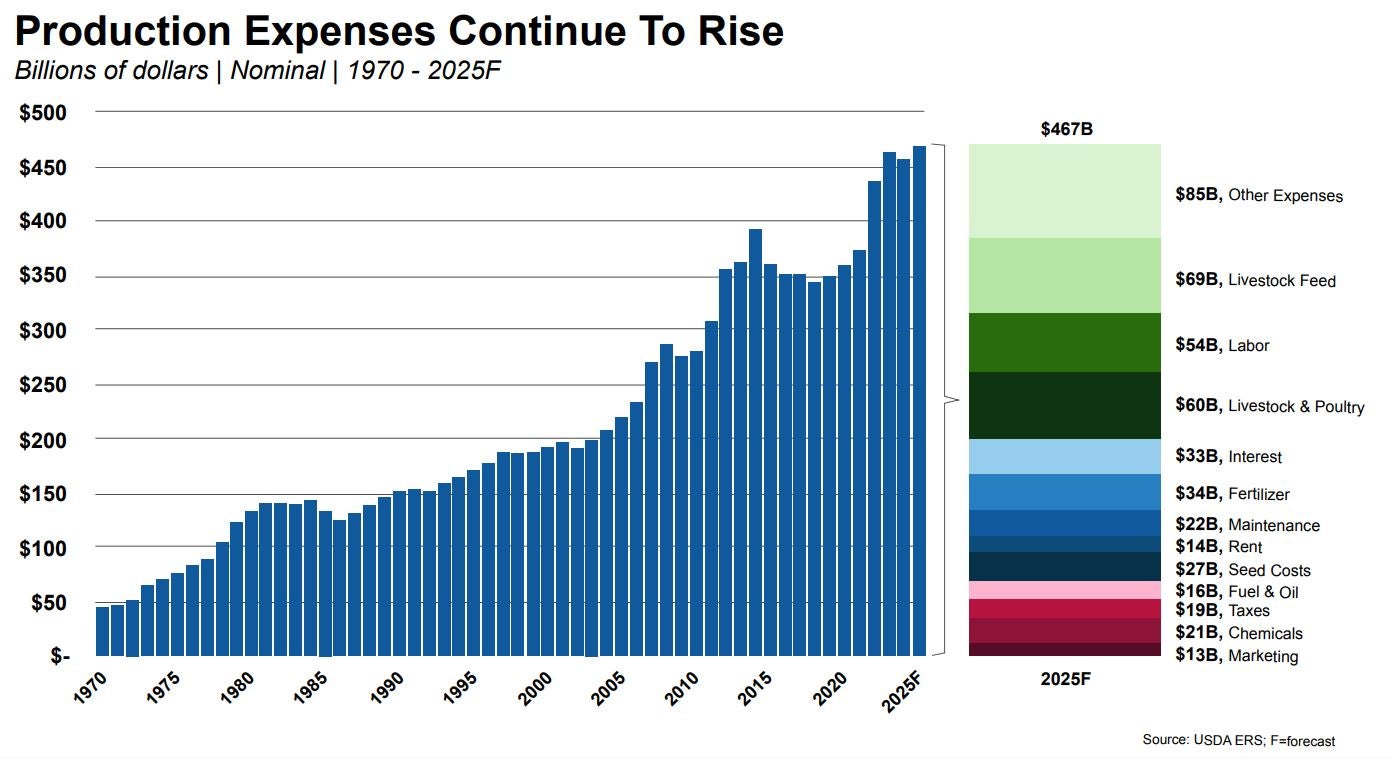
The data presented in the report highlight how sharply production costs have risen. A chart on page 4 shows total production expenses climbing to a forecasted $467 billion in 2025, including $69 billion for livestock feed, $34 billion for fertilizer, $16 billion for fuel and oil, and $54 billion for labor.
Diesel prices alone increased more than 27 percent from 2021 to 2023, while fertilizer costs remain elevated above pre-pandemic levels (AmerComm-HighTechAg2026). As one farmer put it, “[e]ven before tariffs, input costs were already high. Fertilizer, seed, chemical, equipment, fuel, and land costs remain elevated.
These financial strains matter beyond rural communities, especially when considering that agriculture generates more than $9.5 trillion in economic activity, comprises 18.7 percent of the national economy, and supports over 47 million jobs.
Precision agriculture as an inflation-fighter
Rather than advocating expanded direct aid, the report argues that high-tech, precision agriculture offers a durable solution. According to a 2025 report by the Association of Equipment Manufacturers, current adoption of precision technologies has driven a five percent boost in annual crop production, with an additional six percent potential gain if adoption increases.
The same research finds that precision agriculture has helped avoid cultivation of 11.4 million acres — roughly five times the size of Yellowstone National Park.
The cost savings are detailed in practical terms. An eight percent improvement in fertilizer optimization can save up to $20,000 per 1,000 acres. A seven percent reduction in fuel use saves $4,000 per 1,000 acres. A five percent reduction in water usage can save $16,000 per 1,000 acres. Herbicide volumes could decline by as much as 50 to 90 percent as adoption expands.
The report also notes that USDA and NSF provided nearly $200 million in precision agriculture R&D funding between 2017 and 2021, including AI-focused partnerships. Meanwhile, apprenticeships in the agriculture sector have increased by 56 percent over the past five years, reflecting rising demand for skilled technicians and advanced manufacturing workers.
“Technological breakthroughs in the agriculture sector have converged with advanced manufacturing,” the report explains, helping create demand for technicians, data specialists, equipment engineers, and skilled operators.
Case studies: John Deere and AGCO
The report devotes significant attention to two major American manufacturers: John Deere and AGCO.
John Deere, which employs approximately 30,000 people in the United States, recently announced a $20 billion investment to expand its domestic footprint with two new facilities. Among its flagship innovations is ExactShot, a fertilizer system that applies a precise dose directly onto each seed. Farmers using ExactShot can cut fertilizer use by up to 60 percent while maintaining yield. The system allows planters to release 30 seeds per second per row — 720 seeds per second on a 24-row planter.
John Deere’s See & Spray technology was used on more than five million acres in 2025, reducing non-residual herbicide use by 50 percent. A University of Iowa study cited in the report found savings of 4,700 gallons of tank mix and $6,500 in herbicide costs across just 415 acres.
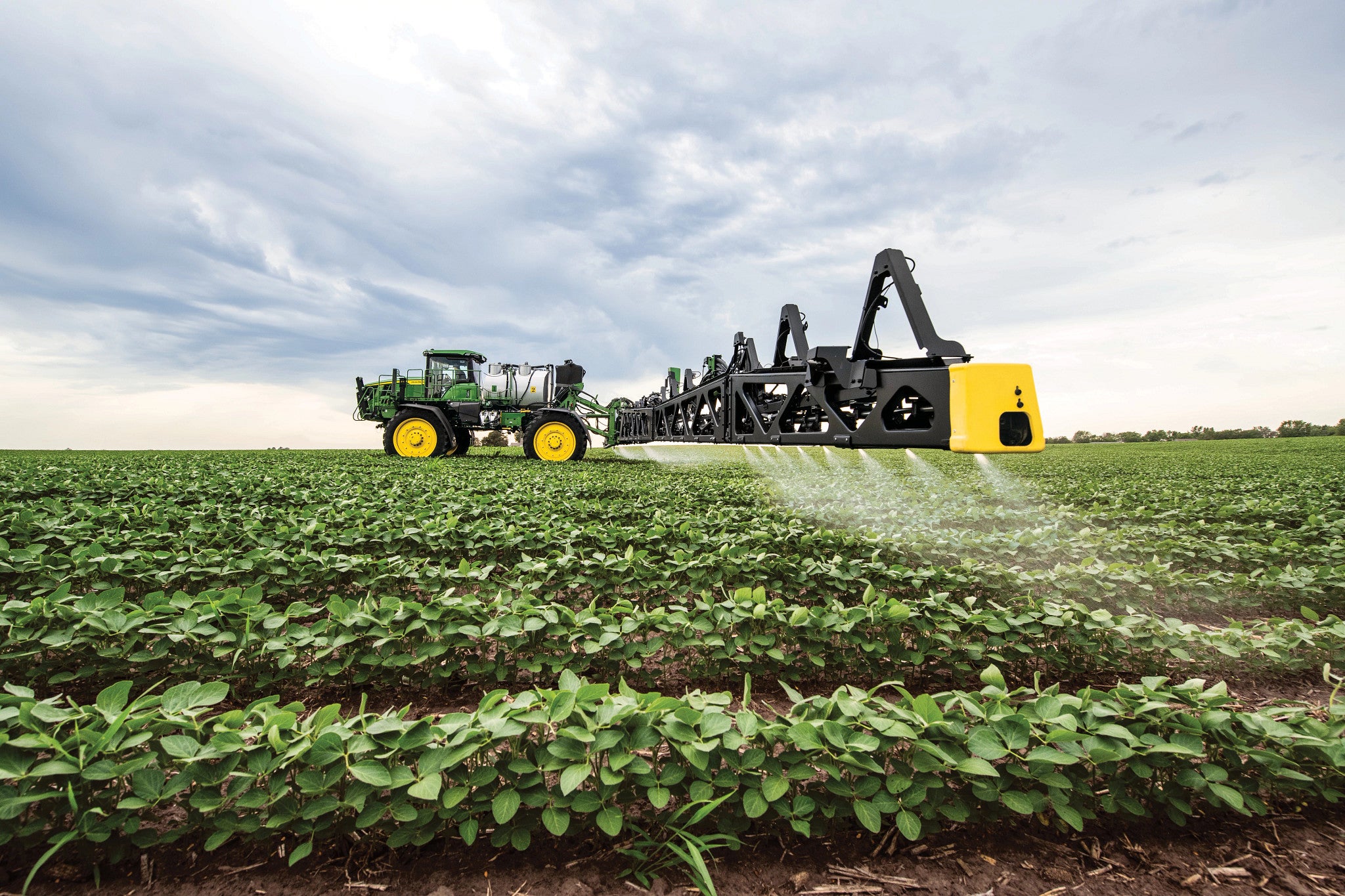
Its LiDAR-based “Smart Apply” system has achieved up to 93 percent reductions in chemical runoff and 87 percent reductions in airborne drift while cutting chemical use in half.
AGCO, headquartered in Georgia and employing over 24,000 people, has developed technologies such as PTx FarmENGAGE, which synchronizes field data and equipment tracking across mixed fleets.
Its AI-powered SymphonyVision system can reduce herbicide use by as much as 70 percent, save more than $30 per acre, and increase grain harvesting efficiency by 33 percent. Other innovations, including SeedSense, vDrive, SpeedTube, and DeltaForce enable near-perfect 99 percent seed singulation rates.
Moving forward, the report encourages policymakers to continue support for the regulatory, property rights and intellectual property ecosystem that has made America the global leader in these pro-farmer advances and in many other sectors. American Commitment reiterates its support for advancing innovation within ag tech through strong protection for intellectual property that allows companies to develop and invest in their ideas and products.
“Policymakers should, therefore, aim to help U.S. farmers and workers capture the maximum productivity gains,” writes Jon Decker, Executive Director of American Commitment. “Doing so will provide both the economic prosperity and strategic leverage that comes with lower food prices at home, increased exports abroad and owning and leading the development of the next generation of systems to feed the world.”