




Agriculture FertilizerAgriculture Fertilizer
  • Home
  • News
  • Management
  • Business
  • Insights
  • Crops & Livestock
  • Machinery
  • Technology
  • Weather
  • Trending
  • More
    • Web Stories
    • Press Release

Subscribe to Updates

Get the latest agriculture news and updates directly to your inbox.

What's On
Northeast Farmers Experience Escalating Tick Encounters

Northeast Farmers Experience Escalating Tick Encounters

January 6, 2026
Farm Bureau Calls on EPA to End WOTUS Uncertainty

Farm Bureau Calls on EPA to End WOTUS Uncertainty

January 6, 2026
Farmer Sentiment Slips in December with Trade Uncertainty

Farmer Sentiment Slips in December with Trade Uncertainty

January 6, 2026
Facebook X (Twitter) Instagram
Agriculture FertilizerAgriculture Fertilizer
  • Privacy Policy
  • Terms of use
  • Advertise
  • Contact Us
Facebook X (Twitter) Instagram
SUBSCRIBE
  • Home
  • News
  • Management
  • Business
  • Insights
  • Crops & Livestock
  • Machinery
  • Technology
  • Weather
  • Trending
  • More
    • Web Stories
    • Press Release
Agriculture FertilizerAgriculture Fertilizer
Home » Study: Mammary glands may boost avian flu risk

Study: Mammary glands may boost avian flu risk

January 5, 20263 Mins Read News
Share
Facebook Twitter LinkedIn Pinterest WhatsApp Email

An ongoing outbreak of highly pathogenic avian influenza has affected more than 184 million domestic poultry since 2022 and, since making the leap to dairy cattle in spring 2024, more than 1,000 milking cow herds.

A new study led by Iowa State University researchers shows that the mammary glands of several other production animals — including pigs, sheep, goats, beef cattle and alpacas — are biologically suitable to harbor avian influenza, due to high levels of sialic acids.

“The main thing we wanted to understand in this study is whether there is potential for transmission among these other domestic mammals and humans, and it looks like there is,” said Rahul Nelli, the study’s lead author and a research assistant professor of veterinary diagnostic and production animal medicine.

Sialic acid, a sugar molecule found on the surface of many types of animal cells, provides an influenza virus the microscopic docking station it needs to infect a host cell, an entry point for attaching and invading. A study by many of the same researchers last year found that dairy cattle udders have high levels of sialic acid, which helped explain why the H5N1 avian influenza outbreak was able to spread rapidly among dairy herds.

In the study published Nov. 27 in the Journal of Dairy Science, a research team that includes scientists from the ISU College of Veterinary Medicine and the U.S. Department of Agriculture’s National Animal Disease Center in Ames also found the same receptors in the mammary glands of the humans.
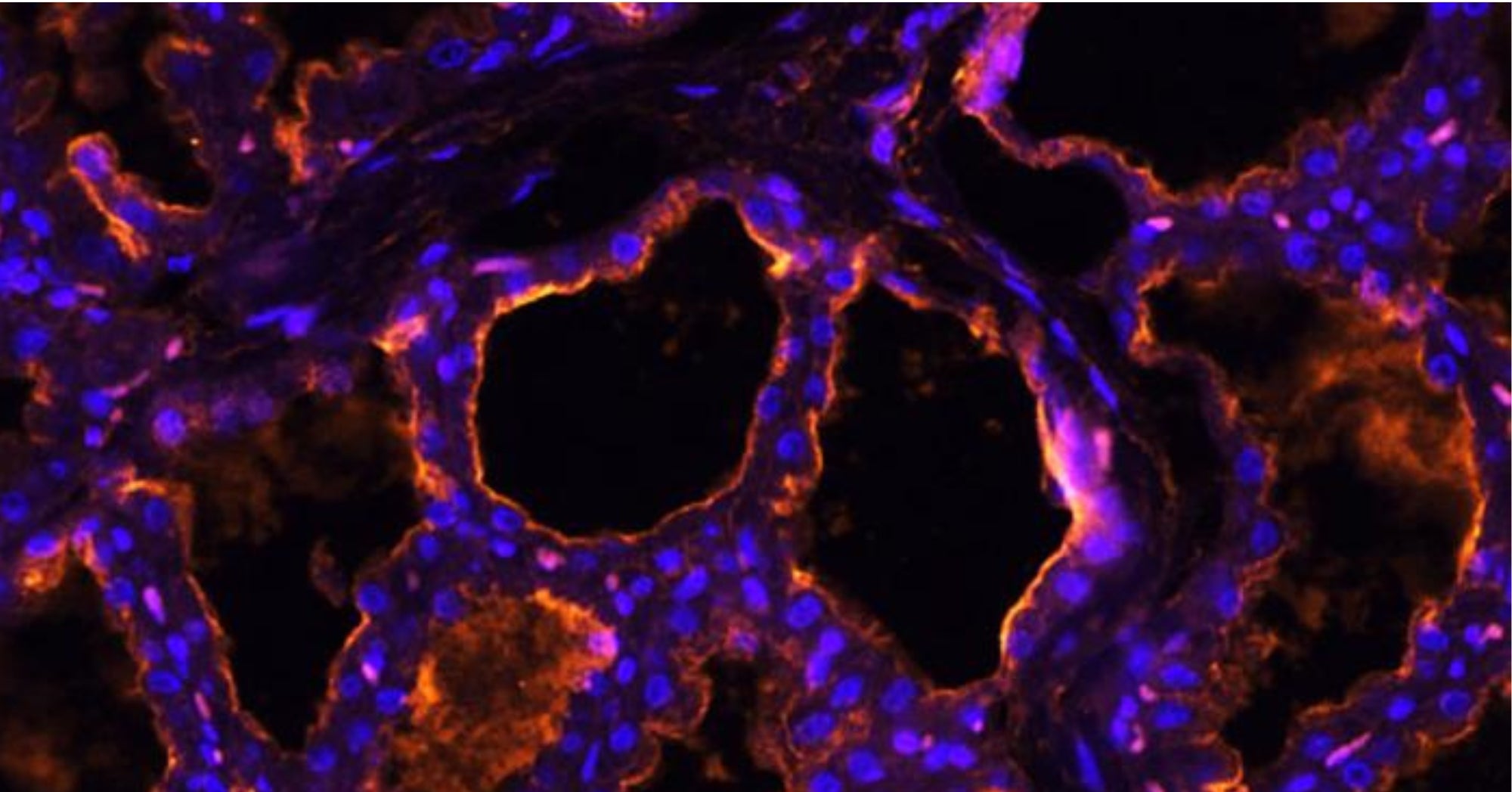
Microscope images of flu receptor in swine mamary gland
Microscope-captured images of a mammary gland of a pig show the presence of influenza receptors. In the image on the left, receptors for avian influenza A are colored orange. In the image on the right, receptors for the type of influenza A that typically infects mammals are purple (Image by Tyler Harm, Iowa State University)

Only a few sporadic cases of H5N1 infection have been reported in the animals examined in the new study, but those species aren’t being tested on a widespread basis, said Dr. Todd Bell, professor of veterinary pathology and a study co-author.

“If we don’t look, we don’t know,” Bell said.

In dairy herds, H5N1 infections are causing sick cows to produce milk contaminated with the virus, prompting nationwide surveillance testing of raw cow milk samples by the USDA. Pasteurization kills influenza viruses, so store-bought milk is safe. But concerns about raw milk should extend to other mammalian livestock, Nelli said.

“Some people do consume the raw milk of these other animals,” he said.

The presence of the virus in milk from infected cows has likely played a role in the H5N1 spreading and makes transmission to humans a bigger risk, Nelli said.

“If a virus in livestock is being spread by respiratory infections, few humans will be in close enough contact to catch it. But milk is an entirely different situation because it’s transported into communities,” he said.

All of the mammary gland tissues examined in the new study had sialic acid receptors preferred by both avian influenza and the seasonal influenza that circulates more readily among humans. The possibility of both types of viruses comingling and transmitting between different species heightens concerns about more dangerous adaptations emerging, Bell said. H5N1 has in the past had a fatality rate in humans of around 50%, though the 71 confirmed human infections during the current outbreak have led to just two deaths.

“We need to try to stay ahead of this so it doesn’t have a chance to continue to replicate and potentially evolve into something even more troublesome,” he said.

Share. Facebook Twitter Pinterest LinkedIn Tumblr Email

Related Posts

Farm Bureau Calls on EPA to End WOTUS Uncertainty

Farm Bureau Calls on EPA to End WOTUS Uncertainty

January 6, 2026 News
Study Finds Climate Benefits in Bayer’s Short-Stature Corn

Study Finds Climate Benefits in Bayer’s Short-Stature Corn

January 6, 2026 News
New bipartisan bill aims to stop deadly tractor rollovers

New bipartisan bill aims to stop deadly tractor rollovers

January 6, 2026 News
‘Ask for help’ mental health and stress tips for farmers

‘Ask for help’ mental health and stress tips for farmers

January 5, 2026 News
Lallemand Animal Nutrition awards K in scholarships

Lallemand Animal Nutrition awards $14K in scholarships

January 5, 2026 News
New World screwworm found in calf 200 miles from border

New World screwworm found in calf 200 miles from border

January 5, 2026 News

Leave A Reply Cancel Reply

Don't Miss
Farm Bureau Calls on EPA to End WOTUS Uncertainty News

Farm Bureau Calls on EPA to End WOTUS Uncertainty

By staffJanuary 6, 20260

DAILY Bites AFBF urged EPA and the Army Corps to finalize a clear, durable WOTUS…

Farmer Sentiment Slips in December with Trade Uncertainty

Farmer Sentiment Slips in December with Trade Uncertainty

January 6, 2026
Study Finds Climate Benefits in Bayer’s Short-Stature Corn

Study Finds Climate Benefits in Bayer’s Short-Stature Corn

January 6, 2026
New bipartisan bill aims to stop deadly tractor rollovers

New bipartisan bill aims to stop deadly tractor rollovers

January 6, 2026

Subscribe to Updates

Get the latest agriculture news and updates directly to your inbox.

Our Picks
‘Ask for help’ mental health and stress tips for farmers

‘Ask for help’ mental health and stress tips for farmers

January 5, 2026

Study: Mammary glands may boost avian flu risk

January 5, 2026
Lallemand Animal Nutrition awards K in scholarships

Lallemand Animal Nutrition awards $14K in scholarships

January 5, 2026
New World screwworm found in calf 200 miles from border

New World screwworm found in calf 200 miles from border

January 5, 2026
Agriculture Fertilizer
Facebook X (Twitter) Instagram Pinterest
  • Privacy Policy
  • Terms of use
  • Advertise
  • Contact Us
© 2026 All rights reserved. Agriculture Fertilizer.

Type above and press Enter to search. Press Esc to cancel.