



Experts say cost, logistics, and limited state funding could all be contributing to the disadoption of cover crop use.
When Levi Lyle was just 6 years old, his father was diagnosed with stage four lung cancer.
With treatment, his father survived his diagnosis. The ordeal changed how he farmed.
“It created an openness in his approach to farming to start doing things differently,” Lyle said.
His father started no-till farming when the practice was still rare in Iowa. A decade ago, when Lyle, now 47, moved back to the family farm, he and his father jumped into organic farming.
“My experiences seeing my father overcome cancer, along with the Agricultural Health Survey’s Midwest cancer statistics, which point to a rural health crisis, inspire me to farm differently,” he said.
Today, Lyle grows corn and soybeans in Keokuk County, in southeast Iowa. Lyle farms about 250 acres, with 40 acres of that organic certified. His father farms an additional 250 acres.
Lyle said introducing cover crops into his practice was a “no-brainer.”

According to the U.S. Department of Agriculture, cover crops are usually grasses or legumes that are planted between cash crop seasons to provide soil cover and improve soil health. Cover crops can reduce erosion and compaction, improve soil’s ability to hold water, reduce nutrient runoff, suppress weeds, as well as provide other services.
Despite being an advocate for cover crops, Lyle said the practice does present challenges.
“The initial challenge is that there is more labor involved,” Lyle said. Cover crops “do not pay for themselves in the short run.”
In the U.S. more than 153,000 farms had land planted in cover crops in 2022.
In Iowa specifically, the use of cover crops has expanded significantly in recent years, growing from 1.3 million acres in 2022 to 3.8 million acres in 2024.
The conservation practice is promoted by the state through cost share incentives. It’s an effort by the Iowa Department of Agriculture and Land Stewardship to reduce the nutrients that go into local waters, make their way into the Mississippi River and ultimately contribute to the Gulf Dead Zone, an annually recurring area of reduced oxygen in the Gulf of Mexico.
According to the Iowa Nutrient Reduction Strategy, an initiative aimed at reducing nitrogen and phosphorus runoff into Iowa’s waterways, to achieve 45 percent nutrient reduction will require about 14 million additional acres of cover crops to be planted.
But a study published in July 2025 in the Society & Natural Resources Journal found that while the number of acres being planted with cover crops has grown, many farmers abandon the practice after one year.
“This study shows that adoption is not a one-time decision — it’s a dynamic process influenced by a range of factors,” co-author Suraj Upadhaya, assistant professor of sustainable systems at Kentucky State University, said in a news release about the study.
Why do farmers abandon cover crops?
Chris Morris, a postdoctoral research associate at Iowa State University, was part of a research team that interviewed more than 3,000 Iowa farmers between 2015 and 2019.
The survey showed that nearly 20 percent of the farmers who reported planting cover crops on their land the first year had ceased using them the following year.
However, the survey found that most of those farmers (15 percent) would be open to resuming the practice in the future.
Only about 4 percent of the farmers who participated in the survey said they have no intention of using cover crops again.
“What we found was a whole lot more shifting back and forth than we anticipated,” J. Arbuckle, professor of rural sociology at ISU, said.
Nationwide, in 2022, nearly 18 million acres, or 4.7 percent of total U.S. cropland, had cover crops, up 17 percent from 2017.
Cover crop use is most common in the eastern U.S. In states along the Mississippi River, Iowa had the most acreage with cover crops in 2022 but Wisconsin had the highest percentage of its cropland using cover crops, at nearly 8 percent. All 10 states saw an increase in cover crop usage from 2012 to 2022, though some states, like Tennessee and Kentucky, saw a drop in cover crop use from 2017 to 2022.
Experts say cover crops present challenges to farmers that can act as barriers to permanent adoption.
Anna Morrow, senior program manager with the Midwest Cover Crops Council, said one hurdle is that cover crop planting overlaps with the busy harvest season.
“Cover crops are a practice where a lot of the labor is right at a peak labor time in our season, right? So obviously [farmers] have to prioritize the cash crop so that they get paid,” Morrow said.
“It’s complicated because a lot of farmers are doing the cover crops in the winter, so between getting the current crop harvested, planting the cover crop, getting that terminated before the next crop, if this cover crop is not going to work in that schedule, it’s going to be abandoned,” Morris said. Morris said barriers beyond timing abound, too, like the cost of purchasing and planting cover crops, balancing the cover crops with other farm work, and challenges that come with farming on rented land.
“A lot of farmers are in really short-term leases, and a lot of farmers feel like landlords aren’t interested in investing in conservation practices on rented land, because they may or may not be farming that land one or two or three years from now,” Arbuckle said.
In Lyle’s case, he owns the 40 acres he uses for organic farming, but he and his father lease the rest of their land. They plant cover crops on both the land they own and rent.
Lyle said for him it’s “economically justifiable” to plant cover crops on his leased land because he expects a “reduction in number of field passes, reduced herbicides, and reduced fertilizer use due to the nutrient scavenging capacity of cover crops.”
To address cost barriers and encourage the use of cover crops, various federal and state programs offer cost-share incentives. Lyle said this year he has been awarded cover crop funding for 150 acres, getting paid $10 per acre. On average, it costs producers about $60 per acre to pay for cover crops.

Morris said these programs are helpful, but farmers told him they often don’t pay enough, require complicated, time-sucking paperwork, and only last one to three years.
But cover crops are a long game, Morris said. While use of cover crops can reduce the need for fertilizer, increase soil health and lead to better productivity, he said those benefits can be difficult to measure and can take years to materialize.
“It’s hard for farmers to justify that high economic cost of cover crops in any given year if there’s not going to be an immediate payoff. Most of these farmers are making marginal profits in any given year, if any, and some are at a net loss. So, there’s a huge weight on farmers’ shoulders of trying to keep the farm going, especially if it’s a farm that’s been in their families for generations,” Morris said. “Anything that could potentially put them out of business is going to seem like a threat.”
Finding new solutions
Cover crops are generally not harvested; rather, their benefits come from simply being on the land. At the end of their life they’re terminated using herbicides or manual methods, like mowing, and tilled into the soil or left atop it as mulch.
But the Forever Green Initiative, which is housed at the University of Minnesota, works to increase cover crop adoption in Minnesota by developing varieties that can improve soil health and also be harvested for sale.
“Agricultural science has not focused on this until very recently, so there are very few options for farmers to do that,” said Mitch Hunter, co-director of the Forever Green Initiative. “We’re working on over 15 different species, and they’re all aimed at filling that niche of a harvestable over winter crop that is winter hardy in the Upper Midwest that can fit into existing crop rotations or become part of a more diverse rotation and as a market.”
He said some commercial and harvestable cover crops have included winter camelina and the perennial grain Kernza, a cousin to annual wheat. He said those crops are “on the cusp of being commercial.” Commercialized cover crops also include alfalfa, winter barley and winter durum.
“The whole point is to fill that gap,” Hunter said.
Pivoting to cover crops that can be harvested and sold is a “natural progression” for many farmers, Morrow said.
“If they start to try cover crops, and they say, ‘Hey, this is working, and I’m seeing benefits.’ And then they’ll say, ‘Well, why can’t I do a winter annual crop and get some cash from this?’” Morrow said. “The Midwest [is] pretty focused on corn and soybeans, but I think there’s some growing interest in winter, annual cash crops.”
Meanwhile, the overall number of acres invested in cover crop practices has been increasing in recent years, even with some disadoption.
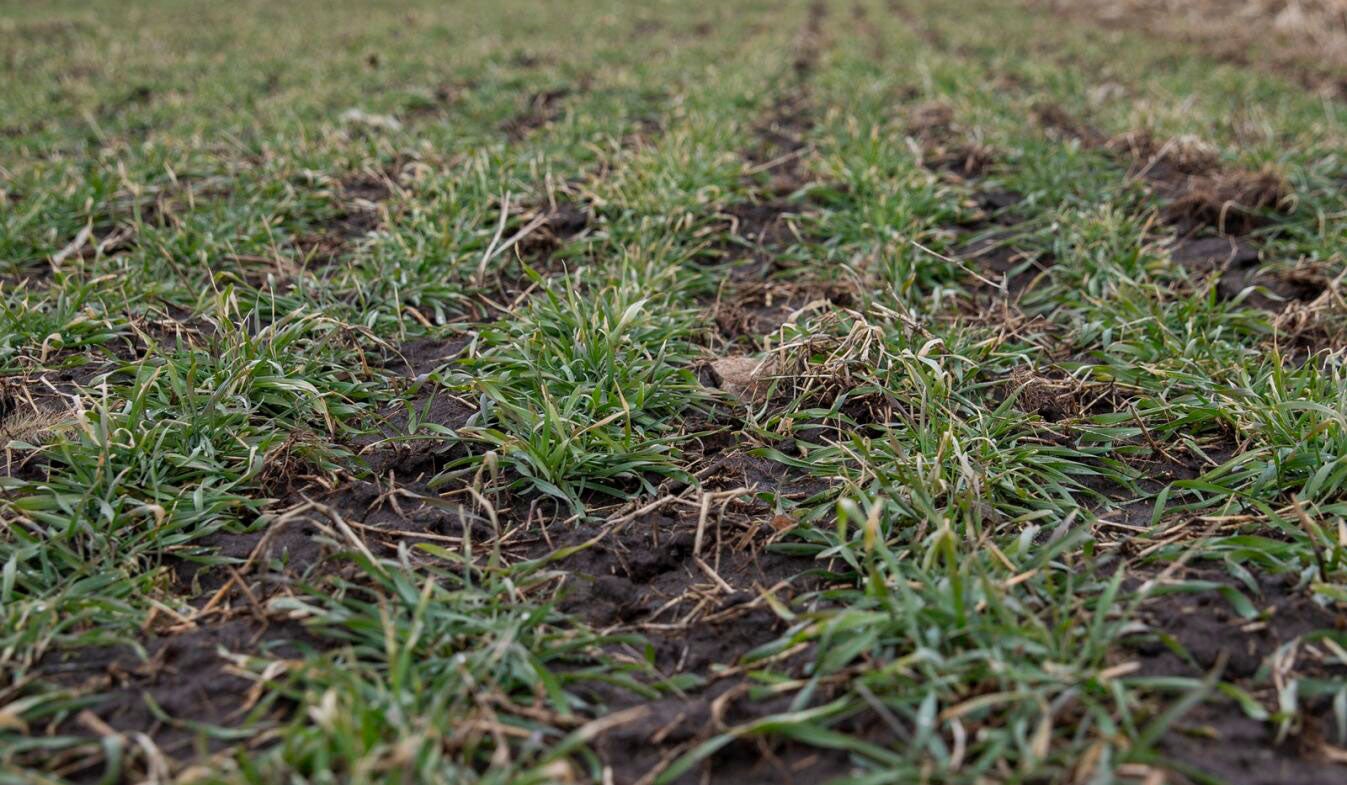
“This study really reflects that farming is a year-to-year business,” said Sean Stokes, research director at the Rodale Institute Midwest Organic Center in Marion, Iowa. “A farmer might only plant a cover crop, like cereal rye, before soybeans, and then when they go to corn the next year, they might not plant that again. But then when they go back to soybeans, they might use cover crops again.”
“Every farmer and every farm is unique, and they’re all going to have different motivations for what’s driving their cover crop adoption,” he said.
Stokes said these motivations could include concerns over water quality or improving soil health.
“For a lot of farmers, it’s a business decision,” Stokes said. “Are they going to see more money per acre in the following years when using cover crops or are they going to lose money? That’s where there is some risk.”
For Lyle, it’s a risk work taking.
“Every acre in the Midwest would benefit from being cover cropped,” Lyle said.
This story is a product of the Mississippi River Basin Ag & Water Desk, an independent reporting network based at the University of Missouri School of Journalism in partnership with Report For America and funded by the Walton Family Foundation.