




Agriculture FertilizerAgriculture Fertilizer
  • Home
  • News
  • Management
  • Business
  • Insights
  • Crops & Livestock
  • Machinery
  • Technology
  • Weather
  • Trending
  • More
    • Web Stories
    • Press Release

Subscribe to Updates

Get the latest agriculture news and updates directly to your inbox.

What's On
Georgia farmland on her mind

Georgia farmland on her mind

December 30, 2025
What Regenerative Agriculture Really Means

What Regenerative Agriculture Really Means

December 30, 2025

Gap Between Farm Costs and Earnings is the Widest in a Decade

December 30, 2025
Facebook X (Twitter) Instagram
Agriculture FertilizerAgriculture Fertilizer
  • Privacy Policy
  • Terms of use
  • Advertise
  • Contact Us
Facebook X (Twitter) Instagram
SUBSCRIBE
  • Home
  • News
  • Management
  • Business
  • Insights
  • Crops & Livestock
  • Machinery
  • Technology
  • Weather
  • Trending
  • More
    • Web Stories
    • Press Release
Agriculture FertilizerAgriculture Fertilizer
Home » Gap Between Farm Costs and Earnings is the Widest in a Decade

Gap Between Farm Costs and Earnings is the Widest in a Decade

December 30, 20253 Mins Read Insights
Share
Facebook Twitter LinkedIn Pinterest WhatsApp Email

U.S. farmers are facing one of the widest gaps in a decade between what they pay to produce food and what they earn from selling it.

U.S. Department of Agriculture data released on Dec. 15 show that by October 2025, the prices paid index had climbed to 154.6, while the prices received index had fallen to 120.5. The agency measures the indexes against 2011 levels, which are set to 100, making it easier to see how prices have changed over time.

In practical terms, that means production costs were more than 50 percent higher than in 2011, while prices farmers received were only about 21 percent higher.
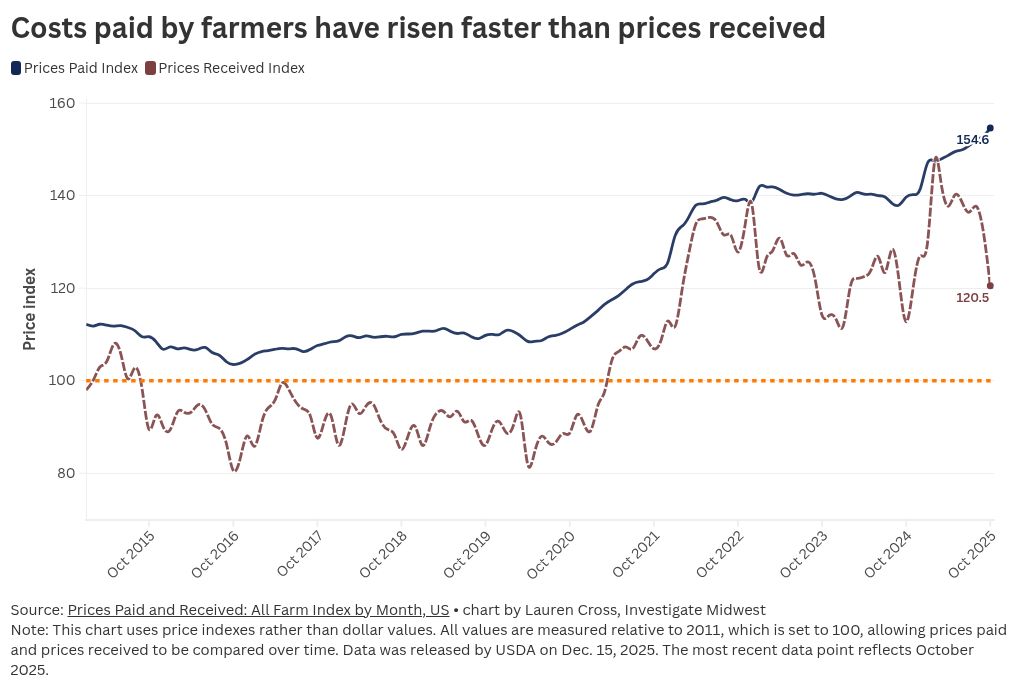
chart visualization

That gap reached 34.1 index points in October, the widest spread in the data going back at least a decade, according to the data. The prices paid index tracks a wide range of expenses, from fertilizer and fuel to feed and labor. Meanwhile, prices for crops and livestock have slipped from their recent highs.

This hasn’t always been the case. In parts of 2021 and 2022, rising commodity prices helped close the gap. Since then, prices received have dropped faster than costs have come down, reopening the spread. These indexes don’t measure profits directly, but they offer a clear signal of rising financial pressure on farm operations heading into the next season.


How does USDA compile this data? 

The price indexes come from a mix of surveys and market data collected by USDA’s National Agricultural Statistics Service.

To track prices paid, USDA surveys thousands of agribusinesses each year about what farmers are paying for hundreds of inputs, including fertilizer, fuel, feed, seed, machinery, and labor. Those prices are combined into a single index that reflects overall changes in farm production costs.
top thirdtop third
Image by Nokwan007, Shutterstock

To track prices received, USDA collects monthly data on what farmers earn for crops and livestock. For major crops, that includes surveys of grain elevators, mills, and buyers. For livestock, the USDA relies on daily and weekly price reports from packing plants and auctions.

The USDA then turns those prices into indexes, setting a base year at 100, to show how prices today compare with earlier years rather than listing dollar amounts.


This article first appeared on Investigate Midwest and is republished here under a Creative Commons Attribution-NoDerivatives 4.0 International License. The piece, known as Data Harvest (formerly Graphic of the Week), is Investigate Midwest’s way of making complex agricultural data easy to understand.

Share. Facebook Twitter Pinterest LinkedIn Tumblr Email

Related Posts

Georgia farmland on her mind

Georgia farmland on her mind

December 30, 2025 Insights
What Regenerative Agriculture Really Means

What Regenerative Agriculture Really Means

December 30, 2025 Insights
Is Trump’s ‘Bridge’ Aid to Farmers Alienating his MAHA Base?

Is Trump’s ‘Bridge’ Aid to Farmers Alienating his MAHA Base?

December 22, 2025 Insights
USDA ‘Regenerative’ Program Capitalizes on a Buzzword

USDA ‘Regenerative’ Program Capitalizes on a Buzzword

December 19, 2025 Insights
More Wolves, More Conflict: Livestock Depredation in Colorado

More Wolves, More Conflict: Livestock Depredation in Colorado

December 18, 2025 Insights
Opportunities to Grow with the USDA’s Tribal College Program

Opportunities to Grow with the USDA’s Tribal College Program

December 18, 2025 Insights

Leave A Reply Cancel Reply

Don't Miss
What Regenerative Agriculture Really Means Insights

What Regenerative Agriculture Really Means

By staffDecember 30, 20250

In a December column on AGDAILY, Perspective: USDA ‘regenerative’ program capitalizes on a buzzword, Amanda…

Gap Between Farm Costs and Earnings is the Widest in a Decade

December 30, 2025
Extreme Weather in 2025 Left a Major Toll on Agriculture

Extreme Weather in 2025 Left a Major Toll on Agriculture

December 29, 2025
Mark Gold’s Weekly Grain Comments for Dec. 29, 2025

Mark Gold’s Weekly Grain Comments for Dec. 29, 2025

December 29, 2025

Subscribe to Updates

Get the latest agriculture news and updates directly to your inbox.

Our Picks
New Year, New Jacket Goals, and Resolutions for FFA

New Year, New Jacket Goals, and Resolutions for FFA

December 29, 2025
Precision Ag is Tracking Toward Robust Growth Through 2030

Precision Ag is Tracking Toward Robust Growth Through 2030

December 29, 2025
Brighter Future Fund: Five years of impact

Brighter Future Fund: Five years of impact

December 22, 2025
 Billion Won’t Cover Farm Losses, but USDA Says ‘That’s It’

$12 Billion Won’t Cover Farm Losses, but USDA Says ‘That’s It’

December 22, 2025
Agriculture Fertilizer
Facebook X (Twitter) Instagram Pinterest
  • Privacy Policy
  • Terms of use
  • Advertise
  • Contact Us
© 2025 All rights reserved. Agriculture Fertilizer.

Type above and press Enter to search. Press Esc to cancel.