






This week, the USDA’s Economic Research Service released its annual Rural America at a Glance report, which provides a high-level look at social and economic conditions in nonmetropolitan (rural) areas of the United States. Specifically, the 20-page report compiles data for things like population change, employment, prominent industry sectors, cost of living, debt, and poverty rates in areas of fewer than 10,000 people.
In a broad sense, the latest report found that economic indicators suggest that nonmetro areas have rebounded from the COVID-19 pandemic economy, which spanned 2020 to 2023. Poverty rates and employment rates both have reached pre-pandemic levels in recent years, and the nation’s nonmetro population increased from 2023 to 2024 resulting from positive net migration, continuing a trend that began in 2021. The best performers were nonmetro counties with recreation-dependent economies.
Tracey Farrigan, one of six authors of the Rural America at a Glance report, presented the data to media members Wednesday afternoon.
She explained that, “Approximately 5.9 million people, or 13.7 percent, of the nonmetro population lived in poverty. This was one of the lowest nonmetro area poverty rates over the last 25 years. … In comparison, the metro area poverty rate decreased by less than 1 percentage point over the same period to 10.2 percent and remains lower than the nonmetro rate.”

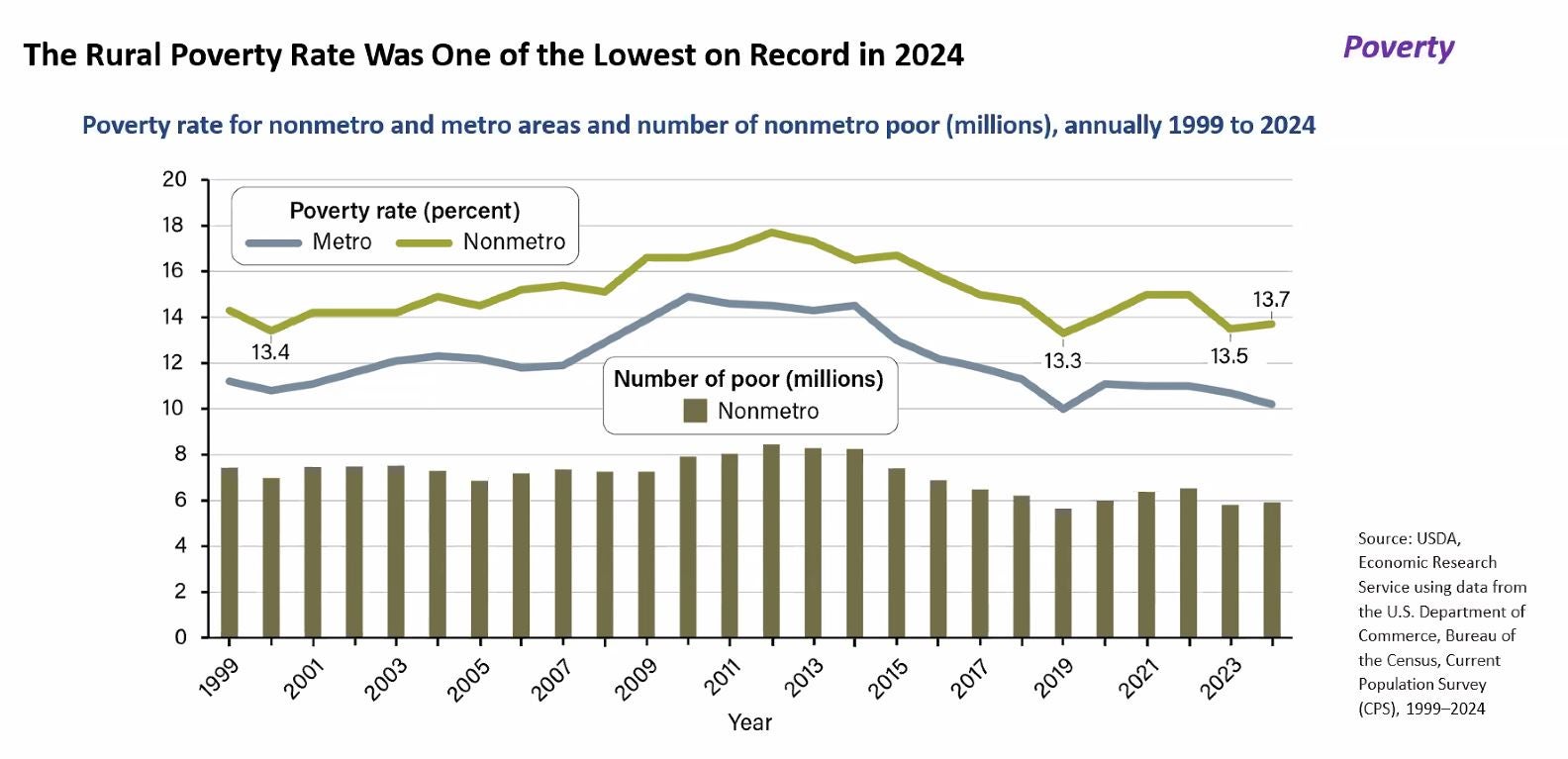
Farrigan, who specializes on research on rural household and community wellbeing with a primary focus on poverty and its intersection with other indicators of rural prosperity, cautioned that “poverty rates were very geographic.” The report noted that a historic North-South divide persists in terms of how extreme the poverty rates are. Farrigan explained that any rates above 20 percent are considered high while below 10 percent is considered low.
Overall, she said, the number of counties with high poverty rates declined. In 2023 there were 370 high poverty nonmetro counties, where 20 percent or more of the population lived below the federal poverty level, down from 403 in 2022. They represented about one in five nonmetro counties and 89.1 percent of all high poverty counties (455 counties) in 2023.
Historically, the report says, nonmetro counties with high poverty were predominantly located in the South and those with low poverty in the North.
Rural population was a major focus of the report. The total nonmetro population increased each year from 2020 to 2024, driven by positive net migration (more people moving in than moving out). However, net migration from 2022 to 2024 has remained relatively stable.
The number of people residing in nonmetro areas in July 2024 was 46.2 million people or 13.6 percent of the U.S. population. This reflects an increase of over 134,000 nonmetro residents over the last year, but a decrease in the share of the total U.S. population (13.7 percent in July 2023) due to a larger increase in the metro area population.

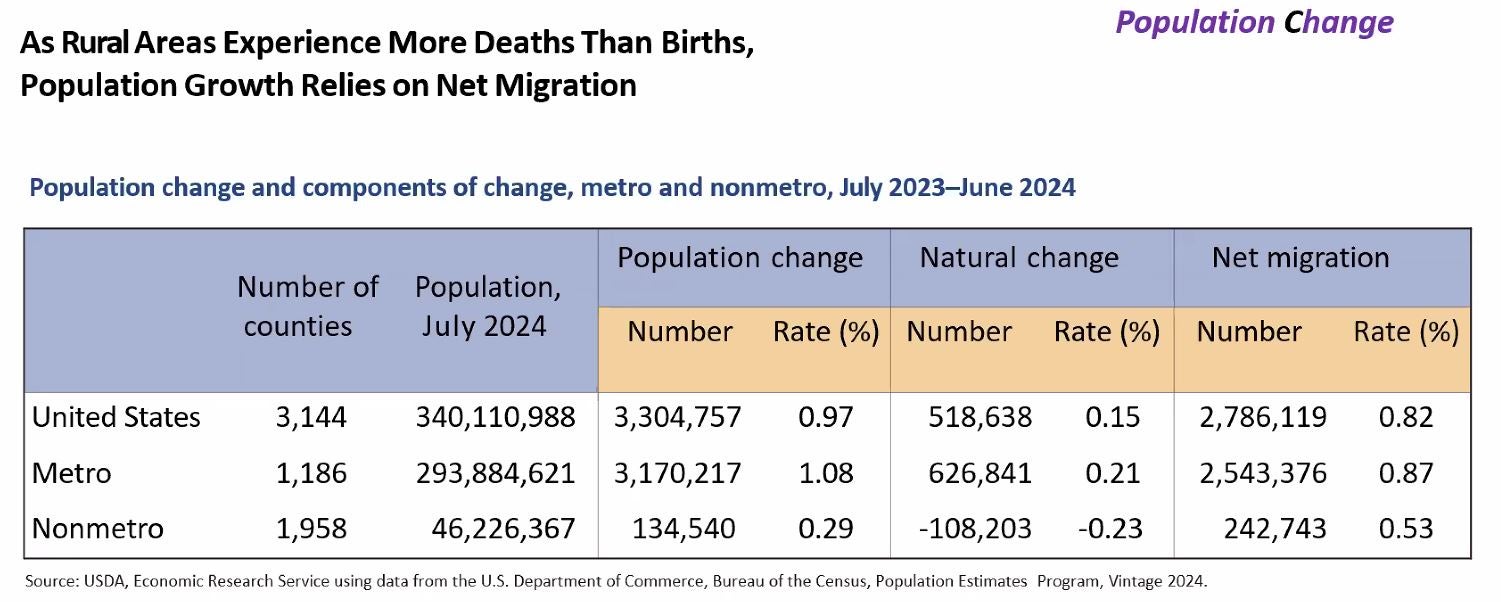
“Non-metro areas experienced more death than births leading to population loss based on natural change alone,” Farrigan said. “However, there was also positive net migration, which means that the number of persons that migrated into nonmetro areas exceeded the number that migrated out.”
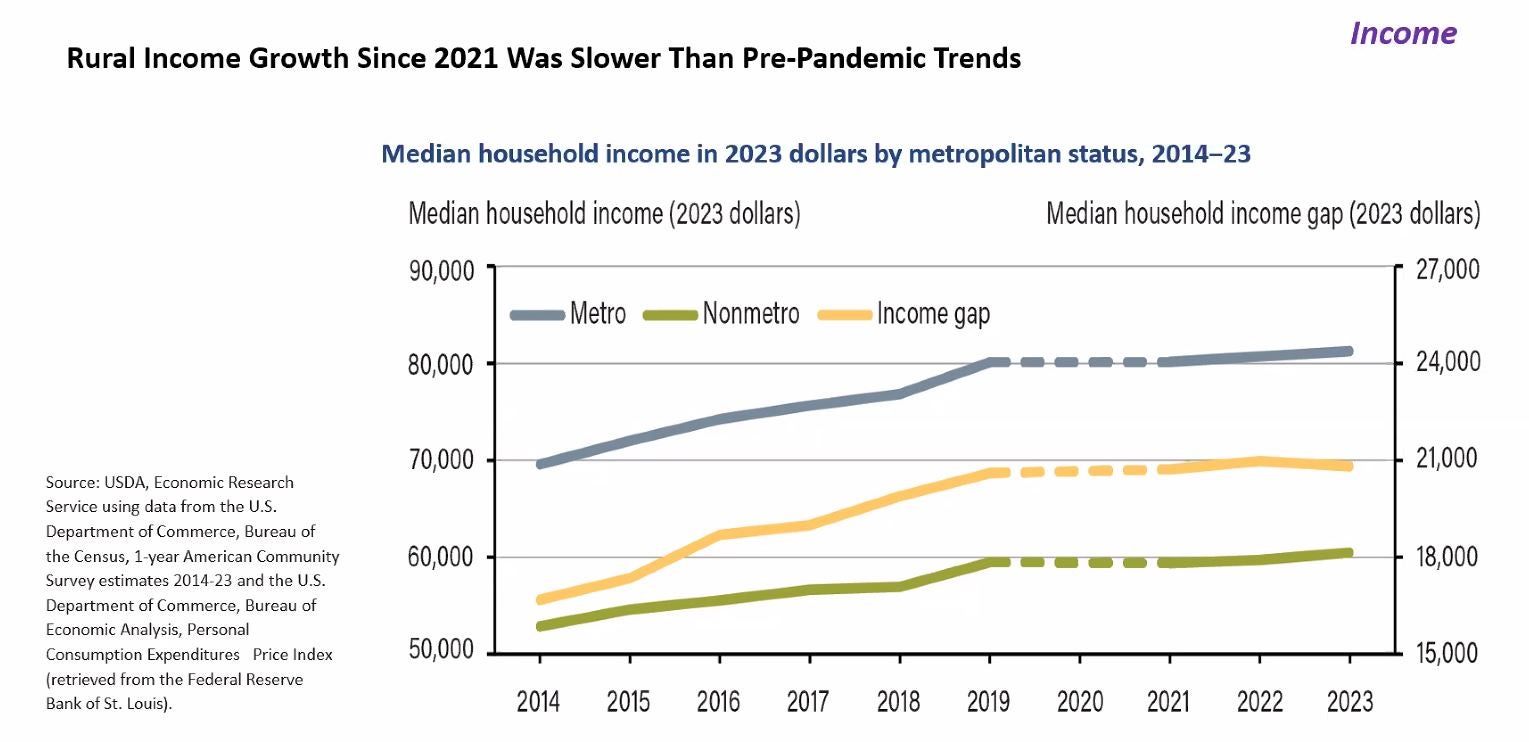
From 2023 to 2024, total employment of nonmetro residents increased by 0.6 percent to 20 million, surpassing the 2019 pre-pandemic employment level. The report said that inflation-adjusted median household income in nonmetro areas grew from $52,872 in 2014 to $60,459 in 2023, an increase of $7,587 or 14.3 percent.
There was a caveat, though, according to Farrigan, “Most of this increase occurred from 2014 to 2019 when average annual growth was $1,324 per year. In comparison, average growth from 2021 to 2023 was less than half that at $527 per year, and this was primarily due to high rates of inflation after 2020.”

Farrigan and the U.S. Department of Agriculture say that the indicators in this latest report suggest a balance of growth and stability in rural America in recent years, while also noting that the at-a-glance style of the report allows for only a basic snapshot perspective.
A deeper dive into the data is vital to understanding the full picture of our rural regions.