




:max_bytes(150000):strip_icc()/54778662706_5ab262825b_o-68d3addad1aa4d36911c1d80274538a9.jpg)
A farm aid package is expected to be announced next week for farmers suffering from export losses and low commodity prices. Agri-Pulse Newsmakers sat down with Deputy Agriculture Secretary Stephen Vaden to discuss the package, which he says “a wide variety of commodity crops” will be eligible for.
In this extended year-in-review interview, the Trump administration’s efforts to advance many agriculture priorities this year — tackling food inflation, advancing trade deals, and consolidation in the meat sector — were discussed. Vaden, who is leading the USDA reorganization, also shared a timeline for when USDA staff will be relocated to five regional hubs across the U.S.
Watch the Episode
Want to receive Newsmakers in your inbox every week? Sign up!
Read the Transcript
Please note: This transcript has not been edited.
Lydia Johnson: Welcome to Agri-Pulse Newsmakers, where we aim to take you to the heart of ag policy. I’m your host, Lydia Johnson. This week, we’ll take you into the Department of Agriculture for a conversation on how President Donald Trump’s agriculture agenda has been advanced this year. Deputy Ag Secretary Stephen Vaden will join us to discuss the waiting economic assistance package, trade, and beef prices. To begin, farmers finished this growing season with mounting concerns about the farm economy, rising input costs, loss of markets and falling crop prices. We asked Deputy Secretary Stephen Vaden what he’s hearing during visits across the U.S. and how he views the farm economy right now.
Stephen Vaden: Well, my view of the farm economy is that we’re trying to get up to speed after treading water for the past four years. There’s been a tremendous focus on trade this year. But what’s important to remember is that for the prior four years, it was the policy that there would be no new trade agreements. So, we are literally taking off from a dead stop and trying to get up to speed. That takes time, but I’m glad. As we got into the third and fourth quarter of this year that we now have wins on the board. We’ve got China, we’ve got those countries in Southeast Asia like Cambodia, Thailand, and Vietnam. We’ve got completely new markets like Uzbekistan, and we’re busting down trade barriers in central and south America. And all of this, when added on top of the China baseline, is new demand for American agricultural goods. So going into 2026, I see us having momentum beginning to build up as we rise from the dead stop of the past four years.
Lydia Johnson: And there’s still generally, you know, pretty strong support from farmers for the administration’s trade policy. But tariffs have raised input costs and, you know, really impacted crop prices. Secretary Rollins calls it a complete realignment of the world economy. And in September said the golden age for American farmers is around the corner. I mean, when should farmers expect this, you know, the golden age for this all to come around?
Stephen Vaden: Well, first, it’s important to remember that the president has removed tariffs on many agricultural inputs. Now that he has these new trade frameworks and trade deals in place, most notably on fertilizer, farmers are seeing that immediately. Second, the One Big Beautiful Bill act is something that’s long overdue. And it kicks in in October of 2026. We’ve got reference prices that actually reflect the raised cost of production caused by the past four years of inflation. And for the first time ever, producers will not have to elect between ARC and PLC for next year. We’ll do the calculation for them. And whichever one ends up being the greatest benefit to their bottom line is what we will pay them. What we’re focusing on now is building a bridge. As I first said at the Farm Progress Show back in Illinois this summer to get them to the one big, beautiful bill start date next year.
Lydia Johnson: Yeah. Let’s talk a little bit more about that bridge. I mean, Ag Secretary Brooke Rollins says that an economic assistance package could be due next week. You know, I’m curious, what can you tell us about the size and scope of that package?
Stephen Vaden: Well, it’s been publicly reported. We’ve set aside funds. We’ve set aside all that we can do here within our current authorities without additional help from Congress, in order to try to take care of the harms that have built up over the past several years in farm country. We know that we’ve got Chinese now buying soybeans, but we know that soybean farmers suffered until that deal was worked out. But we also know there are non-trade related harms, at least non-China trade related harms affecting other commodities, like cotton, for example. And we need to take that into account as we think about the numbers that we need to be providing to farm country with the moneys we have available. Fortunately, all of our USDA employees, those computations are wrapping up. And as the secretary has noted, we will soon be announcing the program and how producers can look forward to it in the new year.
Lydia Johnson: And Chairman Thompson confirmed to our team this morning, actually, you know, that would include, you know, tariff-related losses, but also, losses for, you know, lower crop prices this year, you know, which farmers could benefit from this package.
Stephen Vaden: I think it’s going to be a wide scope of farmers because unfortunately, with lower commodity prices, that’s affecting things across the board. And it’s not all trade related. For example, I want to go back to soybeans, since that has been a primary focus of so many in the non-ag news media over the past year. If you look at the price per bushel of soybeans before the China trade deal was announced and compare that to the price per bushel that it was in 2024, you’ll see almost no difference. We’re talking a few cents. So the overall effect on American agriculture with regards to low prices, it’s not solely a trade phenomenon. It’s not primarily necessarily a trade phenomenon, particularly not with China. We’ve got a supply and demand imbalance, and that’s what we’ve got to work out, because currently we’ve got a lot of supply, because God has blessed this country with a great bounty and all of our farmers with it. I know that many of our corn and soybean and even cotton farmers have had some of their best crops that they’ve ever seen. And we’ve got to find buyers, both internationally and domestically for that bounty.
Lydia Johnson: And I want to dive a little bit more in on the seed package before we move on to more of those broad trade questions. But you mentioned those soybean growers and some of those row crops. But, you know, will this payment package be strictly for row crops or is there an opportunity for forestry, alfalfa, specialty crop, growers to be included in that as well?
Stephen Vaden: We’ve certainly heard from the specialty crop community, as you know, with the non-large commodity crops, that’s a more difficult calculation. You even saw that with some of the disaster relief programs that Congress created, that we paid out over the summer and are continuing to pay out our supplemental disaster relief program, phases one and two. The calculations for the specialty crops were a little more complicated than they were for the row crops. That’s some of what we’re dealing with. I’ll leave it to the secretary to announce the details.
Lydia Johnson: And you’ve previously said that the aid package will account for recent increases in commodity prices. But Senate Ag Chairman John Boozman told our team this week that the administration should be cautious about major recalculations based on the latest price movements. I mean, how are you addressing those concerns and collaborating with Congress to establish this package?
Stephen Vaden: I’ve spoken with Chairman Thompson just last week. As a matter of fact, the day before Thanksgiving, many of his subcommittee chairmen. I’ve also spoken with Chairman Boozman’s staff the great to elder. We’ve been definitely keeping them in the loop. We’ve been hearing their feedback. We’ve been sharing with them what we’re thinking. It’s been a good collaboration, and I think they’ll see their input was taken into account.
Lydia Johnson: Okay. And originally there had been kind of a $12 billion price tag floated on that is that still potentially what will be in this aid package?
Stephen Vaden: How it gets divided up between what commodities — That’s obviously what the announcement is going to be. But we set aside that money for a reason. It’s our intent to use it.
Lydia Johnson: Some lawmakers say that this USDA package, you know, still might not be enough. I mean, that a second aid package might be likely needed too. I mean, do you think that Congress could need to pass a second aid package after what will be expected next week from USDA?
Stephen Vaden: Obviously, if Congress passes the program, we’ll be happy to work with them on it, provide whatever technical assistance is needed, and administer it in Trump time. But right now, we only have these authorities and the moneys provided by the Commodity Credit Corporation. So that’s what we’re focusing on, because we know that come October of 2026, the One Big Beautiful Bill act, which is thankfully permanent law with regard to these key changes that has made to farm programs that have been needed for some time, it kicks in.
Lydia Johnson: China paused many ag purchases this year in retaliation for tariffs imposed by the US. But the new trade deal requires a purchase commitment of 12 million tons this year and 25 million tons annually for the next three years. These purchase amounts are still lower than before the phase one deal. We asked Deputy AG Secretary Stephen Vaden if the commitments in the China deal are enough.
Stephen Vaden: First, it sets a baseline. These are minimum purchase commitments. They’re not a ceiling. They’re free to go over that. Second, it reflects roughly on average what was done during the previous four years. So, in terms of overall change in demand, it reflects a baseline on which we’re building with the other trade agreements that I mentioned, like in Southeast Asia, like with Uzbekistan, of all places, like with Japan. These ancillary trade agreements that are in addition to the China one, that’s been so many people’s primary focus. This represents new demand. And I want to emphasize it’s not limited to row crops. One of the biggest barriers that we face in American agriculture are the European Union’s effort through geographic indicators, to box out so many of our products, because they want to essentially try to get a monopoly on a name. Everybody knows what parmesan cheese is. Everybody knows what champagne is. The European Union thinks they’re the only people who can use those terms. And when American producers make those products and want to sell them overseas, they don’t want to have to deal with the competition. One of the things that I am happiest to see is that Jameson Greer, when he was in Southeast Asia, when he’s been dealing with these countries in our own hemisphere, he is for the first time successfully knocking down these non-tariff trade barriers like the European Union’s effort to essentially keep you from calling a common name, a common name. And they’re falling and countries are agreeing to that, and that’s providing this new market access that is at least as important in the long run as some of these tariff trade barriers that are being broken down are. And I’m happy to see it’s a full court press on ag.
Lydia Johnson: I mean, even if China though, you know, like circle back. But even if China fulfills the agreement recently announced by the Trump administration, farmers have still lost, you know, half of their normal exports to China this year. I mean, how do they you mentioned some of the other trade agreements, but catch up, fulfill that, send product elsewhere.
Stephen Vaden: Well, let’s take soybeans. If I look at the price of soybeans right now, it’s popped more than a dollar from what it was in 2024. We’re sitting on highs of between 15 or 18 months, depending on what particular day you’re looking at. This is because of more secure demand, a trade agreement that the market knows the president will be around for three years to enforce, and they know we’re actually engaged in trade discussions as opposed to the previous four years when there were literally no discussions. That’s the difference. That’s why the soybean price has stayed up above $11. And it’s sustained that momentum. And it’s going to continue to have momentum because this administration will see to it that China keeps its word. And if it doesn’t, there will be consequences.
Lydia Johnson: I’d like to pivot to the government shutdown. You know, some reports are still being released to catch up after the shutdown, and payments for programs like CRP were CRP, excuse me, were recently halted during that. You know, what operations and programs at USDA are you still watching the need to catch up, from the from the very long pause.
Stephen Vaden: Well, thanks to needless politics by the minority on Capitol Hill, most of this wonderful department, a majority of all our employees were furloughed. That included much of the key staff and the research, education, and economics division, which produces the data on which farmers rely. That was needless. It was stupid. It was self-harming, and the minority should have never done that. But I am grateful. That is part of the compromise that Congress reached. With the exception of our Forest Service, which unfortunately must ride on Interior’s appropriation bill, the rest of this department has full-year funding. Whatever happens in January, and in particular with regard to these reports, we’ve got funding through the end of the fiscal year. They’re going to catch up, and we’ll get back on track. And we’re once again issuing the flash trade reports that the market depends on, and we’ll get the data out.
Lydia Johnson: You know, you’ve canceled or delayed a number of important reports. The farm income forecast this week, for example, delayed. You know, I’m curious, has you know, the loss of personnel this year, has that impacted the delay of those reports as well? Many of those economic.
Stephen Vaden: What’s impacted this is for the nearly a month and a half we were shut down. We legally could not work on that. If we don’t have appropriations, we can’t have the employees here to work on it.
Lydia Johnson: The high price of beef has been a major concern for President Trump, while the cattle sector has been one of the real bright spots in the farm economy this year. We asked Deputy Ag Secretary Stephen Vaden how beef prices can be lowered without also cutting cattle prices and farm income.
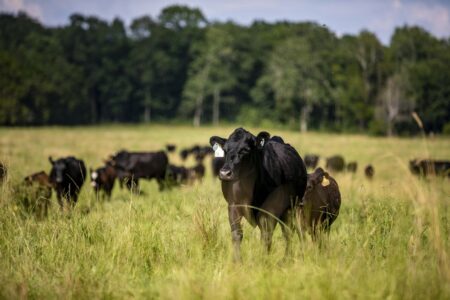
Stephen Vaden: What’s important is that if we’re going to have a healthy supply chain, everybody along that chain needs to be making a little profit, and the consumer needs to be able to pay a price that he or she can afford to pay for product that they want to buy. And right now, we are seeing the pendulum swing to the extreme of the other side. If you and I were sitting here talking three years ago, we’d be talking about the exact opposite circumstance in the cattle market. We’d have farmers who were hemorrhaging money. We’d have the packers who were making money hand over fist, and people would be screaming about that. Now we have the opposite side of the situation because responding to the extreme situation of a few years ago, cattle producers followed the economic signals. They cut back on their herd size. And now we’re seeing the results of that on the other side. What we’ve got to do is we’ve got to have a policy like that. Secretary Rollins announced to help make those pendulum swings not be the boom bust cycle that we’re currently going through. The boom and the bust, depending on which side of the equation that you’re on. We need to have a steady supply of American beef. We need to make certain that the grazing lands, including public lands controlled by USDA and the Department of Interior, are available to grow the herd size. We need to get the government out of the way, and we need to ensure that where we end up is at some point closer to equilibrium. Whereas I said all three parts of the supply chain the farmer, the packer, the grocery store, they’re all making a little bit of money and the consumer is benefiting as well with the price that they can afford to pay.
Lydia Johnson: Let’s talk a little about, you know, the consolidation in the beef industry, this Packers, you know. What is the administration prepared to do about consolidation and beef processing? I mean that’s been a concern of administrations of both parties.
Stephen Vaden: Well, let me step back because there’s been so much focus on beef. Protein includes more than just beef. Apologies to our cattle producers. No insult mentioned, but we’ve got poultry and we’ve got swine as well. I don’t want to forget that. There’s a reason why I’m taking us back to that broader perspective. When I look at the situation in beef right now, what I see is, as I mentioned a few moments ago. You’ve got a major company, Tyson, that has shut down an entire plant and put 3100 people out of work. They’ve closed another one in Amarillo, Texas, and gone down to one shift, putting another 15, 1700 or people or so out of work. This is because they’ve been losing money on it. One of the reasons why they’re losing money is because grocery stores are using their own market power to help the consumer, and saying, we’re not going to allow you to fully pass along to us and force us to pass along to the consumer the even higher price of beef that you’re paying to the farmer. Now, that’s pro-consumer, and that’s good, but it doesn’t necessarily paint a picture of a huge problem in beef. But when we go to the other sectors of it, like poultry and swine, and I, as a lawyer, take a look at what’s happened in the federal courts over the last five years. I can find more than one lawsuit where there has either been a settlement or there has been a finding by a federal court that an antitrust violation has occurred in poultry. And we’ve seen some amazing things. Companies like Walmart, not your typical plaintiff filing antitrust claims against some of these countries. And companies rather, I think it’s reasonable for the secretary and the president to want to take a second look, to make certain that some of those illegalities that were found in prior actions don’t continue themselves in all three sectors of the protein industry, and at the same time, work toward that happy medium that I mentioned earlier, where we’re trying to get out of the boom and bust cycle and see to it that we can stay near the center where all three sides are making a respectable profit, and the consumer is treated fairly as well.
Lydia Johnson: And on the topic of cattle, the border remains closed to Mexican cattle because of New World screw worm. I mean, how long will the border stay closed? What are you watching for to potentially reopen it?
Stephen Vaden: We’re watching to ensure that there’s not going to be a threat to the American cattle herd you know, the one thing that’ll make beef prices go higher. If we have a new world screw worm infection. We eradicated that pest 60 years ago. We don’t want it back. The president secured the border from illegal immigration. We don’t want this fly immigrating over here. So we’re working closely with our Mexican counterparts. Both the secretary and I have met with her Mexican counterpart. We’ve been very plain to them. We’ve got people on the ground from our animal plant health inspection Service. We’re not just trusting, we’re verifying, and we’re wanting to make certain that all of the protocols that both of us have agreed to on a voluntary basis are being followed when we can be assured that the risk to the American cattle herd has reduced to an acceptable level. Then we can talk about in a stage manner. Having a partial border reopening.
Lydia Johnson: The USDA oversaw broad downsizing earlier this year. We asked Deputy Ag Secretary Stephen Vaden if the department is now running more efficiently.
Stephen Vaden: So, we’re committed to in, putting in place Secretary Rollins memorandum. She has delegated to me the ability to do that. You can expect us to march forward through next year and get USDA, not so much right sized as we did a lot of that through the deferred resignation program and voluntary decisions through our employees. We focused on voluntary decisions, not reductions in force, but to get us in the right place and the right place, not just now and for the future. So when you and I talk at the end of next year, what you and I will be talking about, I think, at least in part, is that we’ll be in Raleigh, North Carolina, we’ll be in Indiana, we’ll be in Kansas City, Missouri, Fort Collins, Colorado, and Salt Lake City, Utah. We will have redistributed the majority of our USDA employees to our new hub locations, plus other places where we already have leased office.
Lydia Johnson: You’d like them already to be moved to those locations by the end of 2026?
Stephen Vaden: They will be, as a matter of fact, we’re already moving to implement that, and you’ll see that in the days and weeks ahead with public announcements. And I would encourage anyone who wants to know what we’re doing. We’re being very transparent. We have a website up where anyone news media, USDA employee, member of the general public. You want to know where we are in our reorganization? What our latest announcement is, what we’ve done. We update that on a regular basis with where we are, the documents that support what we’re doing, answers to questions, and there’ll be more information posted there in the not too distant future about the comments that we have received and what our responses are to them, including through our tribal consultation. So, we’re being very transparent, but the future of USDA is in the field because there’s no rural here in Washington, DC, and that’s where our employees need to be. And if we’re going to stay within our budget, that’s where they have to be, because it’s absolutely unacceptable that if you are a government employee, you want to start a career with us here at USDA, but you also want to have a family and a backyard. You’re doing an hour commute one way each way. They’re not a lot of people who want to do that for ten, 20 or more years. That’s how long I want them here. And so in order to see to it that we can have those multi-decade employees and the American public can build on the experience that they are able to have on their behalf. We got to put them in places where they can afford to have a family, and where the government salary will allow them to live the American dream. And unfortunately, that’s not Washington, D.C. anymore. But that is our five hub locations. And so that’s where we’re going there.
Lydia Johnson: And you mentioned you’ve kind of taken charge of reorganization. I mean, historically, the deputy secretary role has kind of operated like a chief operating officer. Role. I mean, how would you describe, you know, your day to day responsibilities and how this role has kind of, you know, shaped, to your strengths?
Stephen Vaden: Well, in the Trump administration, we expect everybody to be able to do what’s needed. Titles aren’t so much important as ability. I’m grateful to work for Secretary Rollins. I’m grateful that she has trust in me and that she allows me to help her, whether it be on the operations of the department, whether it be she’s delegated the reorganization to me, or helping out on policy matters or messaging like we’re doing here today.
Lydia Johnson: Thanks for joining us for another episode of Agri-Pulse Newsmakers. Next week, the House Ag committee will hold Member Day on Wednesday, Ag Secretary Brooke Rollins has teased an aid package for farmers that will be announced next week. Tune in next week and check our website any time for the latest developments on all things food, farm and fuel policy for Agri-Pulse. I’m Lydia Johnson. Thanks for watching.
Agri-Pulse is a trusted source in Washington, D.C., with the largest editorial team focused on food and farm policy coverage.